A card deck for approaching community co-design with more context, curiosity, and care.
As facilitators and design strategists, we spend a lot of time asking people to participate in design processes. Over time, we began noticing some of the same tensions showing up again and again.
Designers can enter a community knowing very little about the relationships, histories, and informal systems already there. Engagement can begin with a problem to solve rather than an understanding of place. And the people easiest to reach aren’t necessarily the people most affected.
We wanted a better way to begin.
What we noticed.
Before asking a community to co-design something with us, we needed to understand more than demographics, stakeholders, and oragnizational structures. Who do people trust? Where do they already gather? Who holds knowledge that isn’t represented by a title? What relationships already exist? Where has trust been lost? Who might we be missing entirely?
These questions were already becoming part of how we facilitated our own work. Community Constellations grew from an effort to make that practice more deliberate.
Turning practice into a tool.
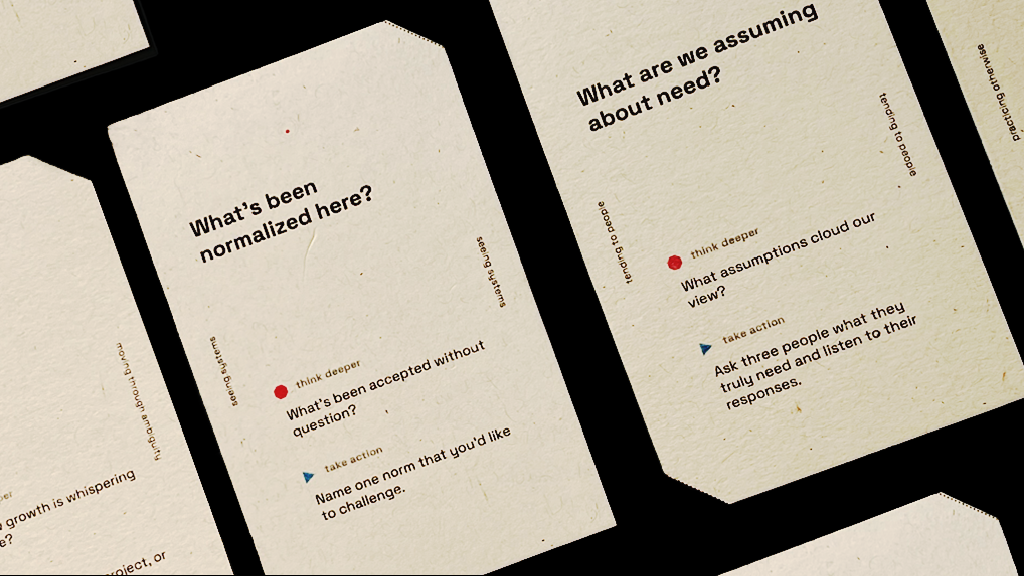
We created a card deck that helps facilitators and design teams explore a community before—and throughout—a co-design process. The cards offer prompts for looking beyond the most visible institutions and stakeholders to consider relationships, histories, resources, places, power, and lived experience.
Rather than prescribing a process, the deck is designed to slow one down. It helps us ask better questions, recognize what we don’t know, and resist arriving in a community with the assumption that design starts with us.
A tool meant to be shared.
Community Constellations began as something we needed in our own practice, but the challenges behind it aren’t unique to lowercase. So we designed the deck to be used by others.
Designers, facilitators, organizations, and community partners can adapt the prompts to their own context—whether they’re preparing for engagement, mapping relationships, facilitating a conversation, or reconsidering who needs to be part of the process.
It isn’t a formula for community co-design. Communities are too specific for that.
It’s a way to arrive more grounded before asking others to make something with us.