MICA. 2024-2025
Translating institutional systems and lived entrepreneurial practice.
**This project was developed through a year-long practice-based studio in MICA’s MA Social Design program, taught and led by Ana. Mashal participated in the studio as a graduate student. The project predates their work together at lowercase and is included here as part of the experiences that shaped our practice.

Printed resources, workbooks, and event collateral created for the "Bridging the Gap" studio and community workshops.
Social entrepreneurship is rooted in community relationships and shared intent. Turning that intent into lasting change takes resources, and access to those resources has never been evenly distributed.
Mission-driven funds exist to change that. Ignite Capital is one of them.
Working alongside Innovation Works, it supports Baltimore's social entrepreneurs, particularly Black-led ventures and leaders who face systemic bias in raising investment, with the aim of narrowing the city's racial and spatial wealth gap. Its funding is shaped around each enterprise and comes with mentorship and ongoing support. In their words, they invest in people.
Even so, Ignite noticed a pattern across cohorts. Entrepreneurs were doing deeply impactful work, but when it came time to secure funding, they were expected to speak a specific institutional language of financial models and planning frameworks that rarely matched their day-to-day reality. Ignite partnered with MA Social Design students at MICA for a practice-based studio to explore it.
It wasn't a lack of financial discipline. It was a translation gap.
Slowing down to listen
That was the challenge as it was described to us. We took it seriously, but we didn't want to treat it as the answer. Before drawing conclusions, we wanted to hear from the people living it.
We began by spending a year immersing ourselves in financial modeling, investment structures, and real-world entrepreneurial bookkeeping, to understand what entrepreneurs were being asked to navigate. Then we interviewed people individually: entrepreneurs, mentors, lenders, and investors, many from Ignite's network. We weren't only asking which financial tools were missing. We were paying attention to how power, trust, and risk were communicated within these relationships, and treating lived experience as expertise.
Bridging the Gap
Those conversations began separately with each group. We then brought everyone under one roof for a culminating event, "Bridging the Gap," welcoming mentors, lenders, and entrepreneurs from within Ignite's network and across the broader Baltimore ecosystem.
Facilitated table discussions used role-play with our Facilitation Card Deck, along with journey mapping in interactive workbooks, to surface the emotional and relational dynamics around money. The convening closed with partner-swapping exchanges, where participants shared lived experiences, unpacked power dynamics, and built trust across roles.
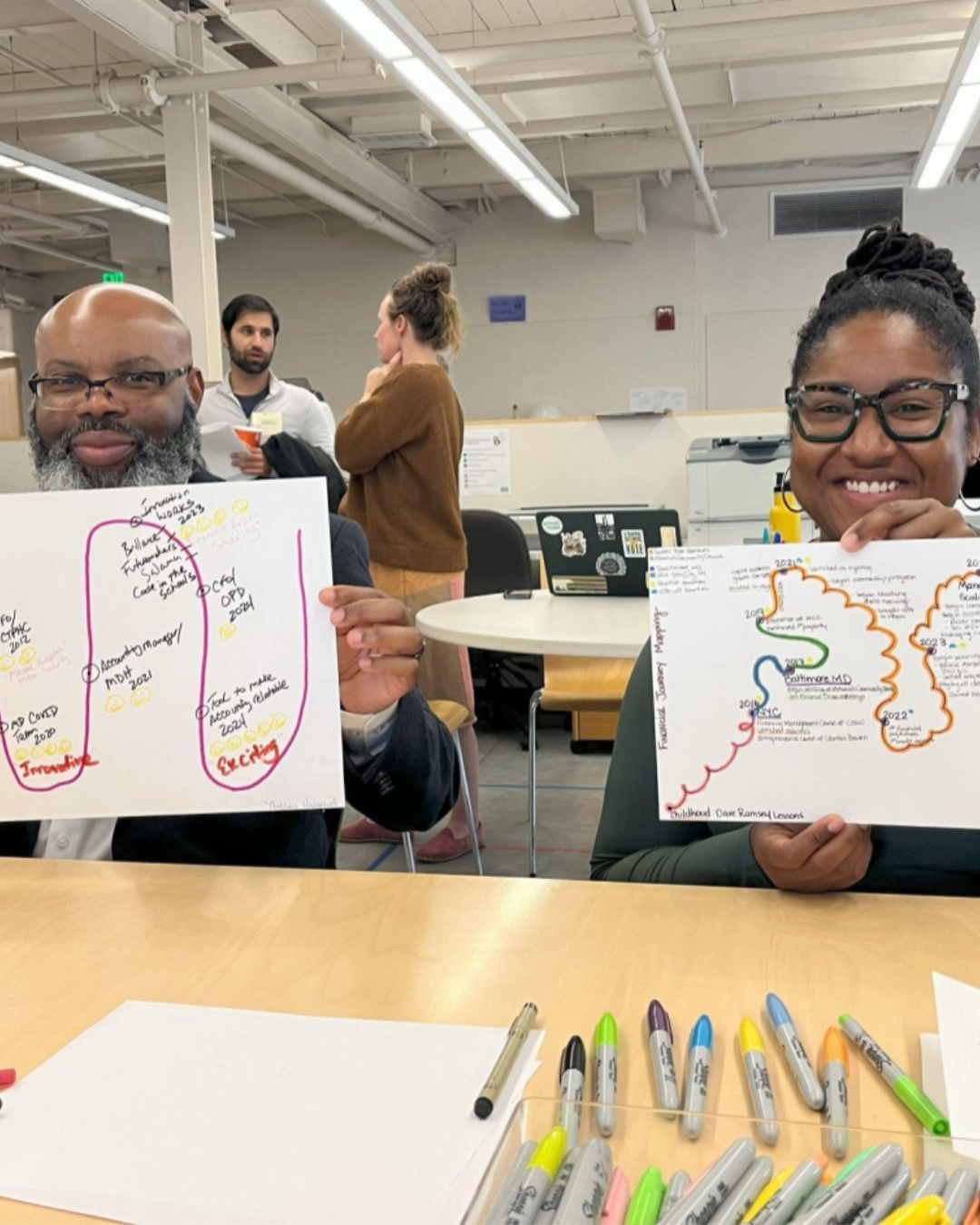
Participatory session at MICA’s MASD studio: Journey-mapping financial learning experiences with mentors and social entrepreneurs
What we noticed
We brought what we'd learned back to Ignite Capital in a culminating presentation. Three insights stood out:
The vocabulary of lending signals who belongs in the room, and many entrepreneurs read it as a sign that they didn't.
Entrepreneurs were already making sound financial decisions, but in forms that don't map onto formal templates.
Lenders and entrepreneurs each assumed the other understood how risk and trust were being communicated.
Creating shared language
We turned what we'd heard into an interactive toolkit workbook for entrepreneurs. It includes exercises, worksheets, and templates that help them work through financial planning in formats that start from their own practice, not from institutional forms.
Rather than asking entrepreneurs to conform to rigid jargon, we started from a different question: what would it take for both sides of the table to understand each other? Financial clarity shouldn't depend on who can perform the right vocabulary. When people see their own practice reflected in the systems meant to support them, they can enter the conversation with confidence and help shape it.
Our scope ended with the toolkit. We would have loved to see it tested with entrepreneurs, to learn how it holds up in real use and let them reshape it. A tool meant to give people more say in the conversation should be refined with them.
"Bridging the Gap" was never about fixing entrepreneurs. It was about building shared understanding, so that the people doing the work in their communities hold real power in the conversation about how that work is funded.
Delivered:
20+ one-on-one stakeholder interviews
financial model audit
attendance in industry event for observation
Community Engagement Session - Bridging the Gap.
Visual and Branding Identity of Event.
Workbook Design
Card Deck Activity Design
Report Design
Toolkit Design
Credits: MASD Studio, Wild Bay Kombucha, Lindsey Henley, and the people in the photos.
